Calm under a mounted gun. Panicked over a deadline.
State before Strategy, Part 1
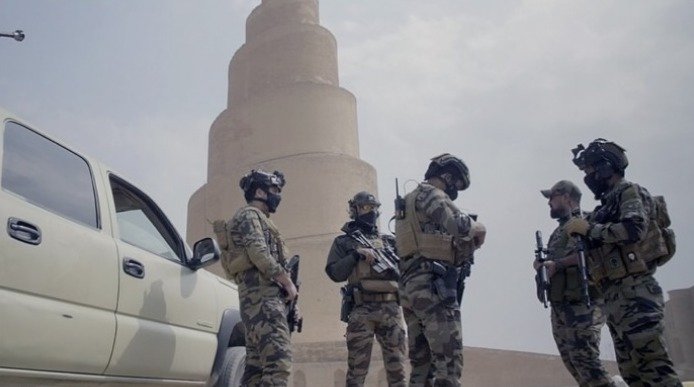
In early 2023 I was filming for ARTE in Iraq with a Shia militia, one of those groups steered by Iran. We rode along on their truck, a huge mounted gun on top.
And I was calm. Not a little bit calm. Extremely calm.
After everything I had learned about stress, I should have been in a panic. It doesn't get much more extreme than that, short of standing in a hail of bullets. And still there was no stress in me.
Behind the camera I'm often completely present. Very little thinking, just what's happening in front of the lens. And when we're present, all hell can break loose around us and we stay focused.
On the truck with the gun: calm. In a meeting about a shaky deadline: alarm. If the pressure came from the situation, it would have to be exactly the other way round.
Monday morning. A project is going wrong. The client is annoyed, the deadline is wobbling, and the meeting starts with who messed it up. What we need right now are creative ideas and people who listen.
And what do we do? We turn up the pressure.
Kind of fascinating, isn't it? Anyone who is busy preparing their defence speech in their head has little room for a fresh idea.
What I experienced on that truck is physics. Not psychology. Physics.
Physics and engineering
An engineer who doesn't know physics can still build houses. They just don't stand quite as firmly, and he probably dares less. If you run a business, you build all day long: strategies, processes, teams, decisions. I call that engineering. And the engineering is usually not bad at all. It just stands on a physics nobody ever explained to us.
By physics I mean what makes our experience possible in the first place. The rules before the game begins. Gravity doesn't ask whether you believe in it either.
What the physics says
First: We think. Nonstop. All day and half the night. Thoughts are like trains pulling into my station. I can't influence which trains arrive, and there's no timetable. This principle is called Thought.
Second: We experience what we think. There's a power in us that brings every thought to life, with heartbeat, stomach, the whole package. I call it a full body experience. Thinking and feeling are one energy, not two. This principle is called Consciousness.
Third: We never experience the situation. We always experience our thinking about the situation. Every human being, in every moment. There are facts, numbers, clients, trucks with guns on them. But I can only perceive them through my thinking. That's why eight billion people live in eight billion worlds, moment by moment.
David Bohm, a quantum physicist, put it in a nutshell: "Thought creates the world and then says, I didn't do it."
That's exactly what happens in every meeting. It feels as if my experience comes from the number, the client, the market. But it's 180 degrees the other way round. Thinking is an independent factor.
On Monday I see that the team is behind schedule and I stay calm. On Tuesday I see the same situation and fall apart inside. The situation hasn't changed. My thinking has.
At the cinema this is perfectly clear to us. I sit in the theatre, I jump or I cry, and at the same time I know it's just light falling on a screen. The feeling is real, the monster isn't. In everyday life we take the thought movie for the world. If engineering is the movie, then the cinema is the physics behind it. And seeing that cinema is what this is all about.
Part two is about what this means for businesses: for decisions, for creativity, and for high performance that doesn't have to end in exhaustion.
State before Strategy. State first, then the plan.